BM&T is a specialist turnaround and restructuring firm, trusted to restore control, protect value, and unlock long-term resilience. We step in when it matters most, bringing hands-on leadership, ethical judgment, and cross-border expertise to stabilise performance, realign strategy, and restore confidence in complex, high-stakes situations.
Expert-led turnaround and restructuring solutions designed to stabilise businesses, restore value and drive sustainable growth. Our hands-on approach ensures decisive action, stakeholder confidence and long-term success.
From global enterprises to mid-market firms, BM&T supports leaders across industries in moments of disruption and complexity. Our sector specialists bring operational insight and cross-border experience to stabilise performance, protect value, and guide recovery.
Explore our latest insights, case studies, and thought leadership on turnaround management and restructuring. From real-world client outcomes to expert commentary on emerging challenges, these resources reflect BM&T’s experience in action.
Businesses can become strategically distressed before they become financially distressed.
In this Insight, I contend that the most significant moment in a business crisis is rarely the day the company can’t pay salaries. By then, many of the best options have already disappeared.
The more important moment often came six, twelve or eighteen months earlier — when the business was still paying creditors, still inside its facilities and perhaps still reporting a profit, but its resilience, relevance or capital structure had already begun to deteriorate. That matters because the traditional picture of distress is often imagined as a linear process: profits fall - cash tightens - creditors stretch - covenants breach - insolvency risk. Ernest Hemingway famously captured the dynamic in The Sun Also Rises: “Gradually, then suddenly.”1
Cyber risk, AI, supply-chain interruption, regulation and geopolitical volatility now sit among the most significant concerns facing businesses. Allianz’s 2026 Risk Barometer ranks cyber incidents first globally, AI second and business interruption, including supply-chain disruption, third. Only 3% of respondents described their supply chains as “very resilient”.2 At the same time, AlixPartners reports that 70% of CEOs experience high levels of disruption, while 72% say it is becoming harder to decide which disruptive forces to prioritise.3
The conclusion for boards, owners and lenders is uncomfortable: A business can be solvent — and already in distress.
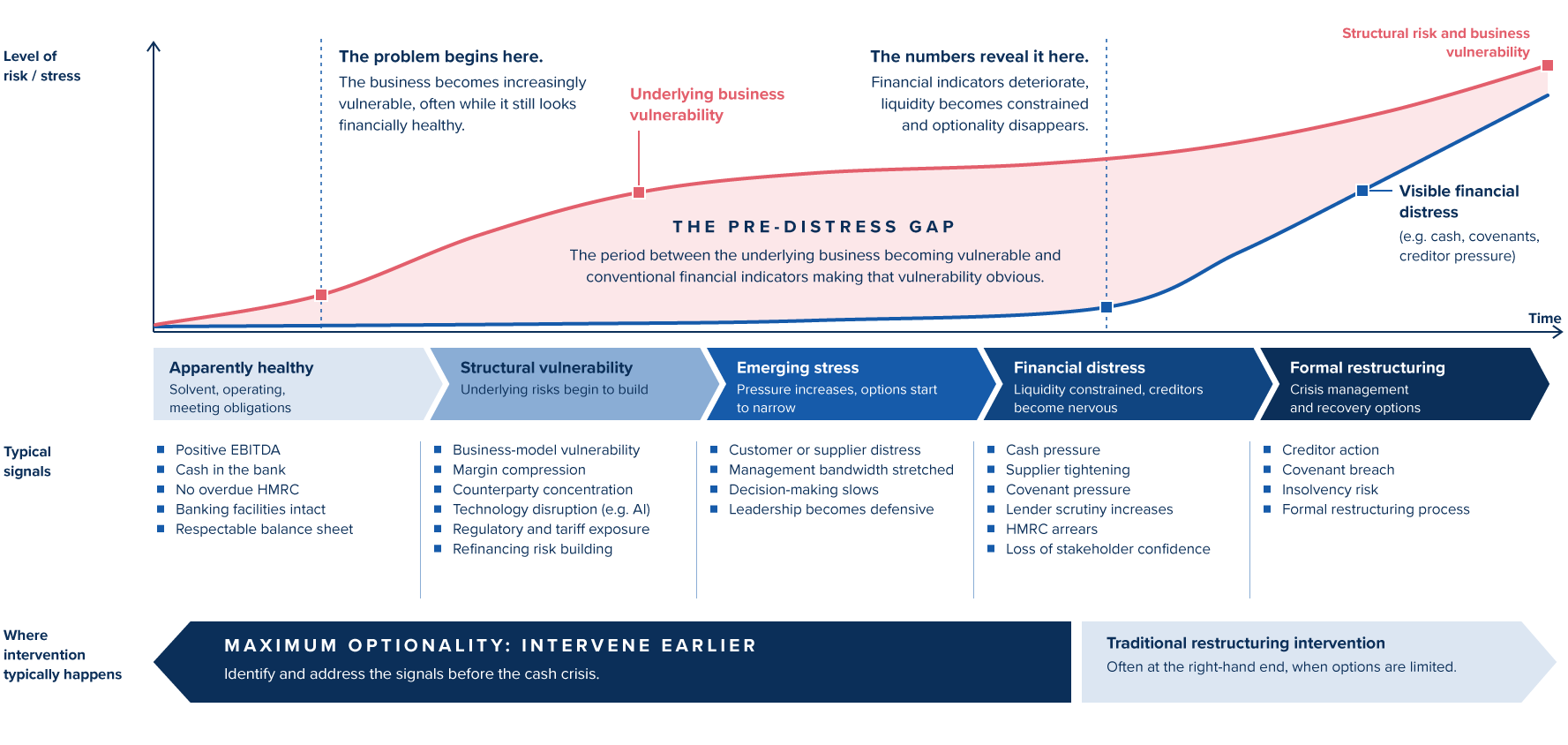
The Pre-Distress Gap
Financial distress is often the final symptom of a problem that began somewhere else.
We call the period between the underlying business becoming vulnerable and conventional financial indicators making that vulnerability obvious the Pre-Distress Gap.
A company can have positive EBITDA, cash in the bank, no overdue HMRC, intact banking facilities and a respectable balance sheet, yet still have developed a structural viability problem.
The question is not simply: “Are we solvent today?” It is: “What is already changing that could make this business unviable tomorrow?”
Most restructuring intervention still happens at the right-hand end of that gap, when liquidity is constrained, creditors have become nervous and optionality is disappearing.
The opportunity is to move left. That means identifying the signals that appear before the cash crisis.
Signals that appear before the cash crisis
1. Business-model vulnerability
The first question is brutally simple:
“If we started this business today, would we build it this way?”
Technology can alter the economics of a business before the financial statements visibly deteriorate. AI is the obvious contemporary example.
The turnaround question is not whether the company has adopted a new tool. It is whether technology changes what customers will pay for, how quickly competitors can replicate the offer, or whether part of the existing value proposition is becoming obsolete.
I moderated a session on AI at the 2025 TMA Global distressed investors conference in Las Vegas. A CEO for a global organisation told his legal counsel, in front of attendees, “Gone are the days when we will pay $1,000 for an NDA. We will only pay a fraction of that cost to senior counsel to add value. We are not prepared to pay your firm for drafting time.”
The same applies to regulation, routes to market, customer behaviour and geopolitical change.
A profitable model can still be becoming irrelevant.
Boards need to distinguish current performance from future viability.
2. Margin shock
Many businesses know their current gross margin.
Far fewer know the margin at which their operating model stops working.
A business with high fixed costs, weak pricing power and significant working-capital requirements can move from profitable to distressed surprisingly quickly.
The turnaround question is not: “What is our margin?” It is: “What happens if gross margin falls by 300 basis points? Then 500 basis points? What if wages rise at the same time, supplier terms shorten and energy or freight costs move against us?”
The purpose is not pessimism. It is to understand where resilience ends. By the time those effects appear in monthly EBITDA, the cash consequences may already be embedded.
3. Counterparty contagion
A company’s own solvency is only part of its risk.
Allianz Trade forecast that global business insolvencies would rise in 2026, marking a fifth consecutive annual increase. It expects UK insolvencies to remain around 30% above pre-2020 levels.4
The turnaround question is “Whose insolvency could make us insolvent?”
It may be the largest customer, a principal contractor, a single-source supplier, distributor, funder, shareholder, foreign subsidiary or strategic partner.
Counterparty failure can arrive through unpaid debt, supply interruption, lost volume, contractual claims or the sudden withdrawal of funding.
The board should know where the business is one failure away from its own crisis.
4. Refinancing viability
Another dangerous comfort is: “We can service our debt.” That is not the same as: “We could refinance our debt today.”
The Bank of England reported in July 2026 that around 20% of riskier debt was due to refinance by the end of the following year, with highly leveraged borrowers particularly exposed to tighter conditions. It also noted the use of amend-and-extend and payment-in-kind structures to push refinancing pressure into the future.5
That phrase matters: pushing risk forward.
A business may be current on every payment and still have a capital structure that will not refinance on sustainable terms.
The turnaround question is not whether today’s interest can be paid. It is whether tomorrow’s capital can be replaced.
Financial distress is often the final symptom of a problem that began somewhere else.
The human operating system of resilience
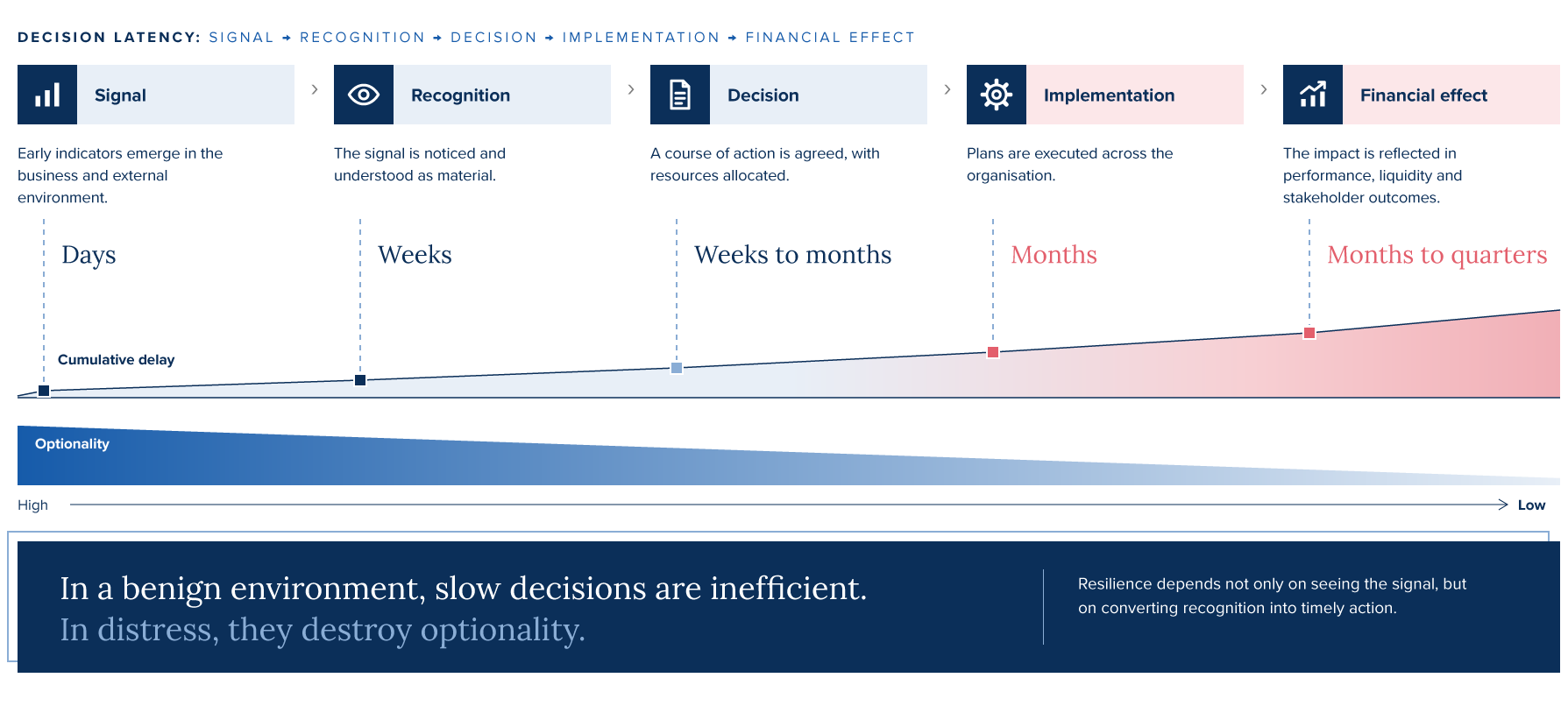
5. Decision latency
Businesses do not always fail because management failed to see the problem.
They can fail because the organisation cannot convert recognition into action quickly enough.
In a benign environment, slow decisions are inefficient. In distress, they destroy optionality.
Businesses do not always fail because management failed to see the problem.
They can fail because the organisation cannot convert recognition into action quickly enough.
In a benign environment, slow decisions are inefficient. In distress, they destroy optionality.
AlixPartners’ 2026 Disruption Index found that 72% of CEOs say it is increasingly difficult to determine which disruptive forces to prioritise, while 85% say they need greater support.3
6. Management bandwidth
This may be the least measured risk of all.
In many owner-managed and mid-market businesses, one person may simultaneously be the chief executive, own the largest customer relationship, manage the bank relationship, make the key commercial decisions, act as shareholder and remain the HR escalation point and de facto strategy function.
That can work extremely well while conditions are stable. Then one unexpected event overwhelms the system.
Management capacity is therefore not a soft issue. It is an operating constraint.
The turnaround question is “Does this team have the capability and bandwidth to deal with the next problem without dropping the existing business?”
A board can have a viable strategy and still fail because nobody has the capacity to execute it. That does not appear in EBITDA.
The BM&T Pre-Distress Test
01.
What could make our current business model materially less valuable within the next 24 months?
02.
What single customer, supplier, lender, shareholder or jurisdiction can hurt us disproportionately?
03.
At what margin does our operating model cease to work?
04.
Could we refinance our current capital structure today?
05.
How quickly do we turn adverse information into decisions and action?
06.
What happens when management capacity becomes the constraint?
If those questions cannot be answered confidently, the absence of a cash crisis does not necessarily mean the absence of distress.
When recognition is not enough
Identifying vulnerability does not itself create resilience. Boards may understand the problem but still lack the bandwidth, independence or operating discipline to act quickly enough. This is where experienced turnaround leadership and the CRO role can add value before formal distress. The task is not simply to diagnose risk, but to establish control, create one version of the truth, convert decisions into accountable actions and preserve options while they still exist.
From rescue to prevention
Turnaround has traditionally been associated with the moment after performance has broken: liquidity control, creditor management, restructuring, cost reduction and formal rescue.
Those capabilities remain essential. But the greater opportunity is to move upstream, while the business still has time, liquidity and choices.
For
Where earlier intervention helps
Boards
Test vulnerability before it appears in the monthly management accounts.
Independent challenge can expose where the business model, margins, capital
structure, leadership capacity or operating assumptions are beginning to weaken,
and help management decide what needs to change while options remain open.
Lenders
Look beyond historic financial information to the business behind the numbers.
An independent operating review can test management capability, commercial
resilience, concentration risk, decision velocity, cash sensitivity and future
funding viability – identifying emerging borrower risk before it becomes a workout
case, while also revealing businesses where additional finance, strategic support
or deeper engagement could unlock value.
Investors
Distinguish temporary underperformance from developing structural weakness.
Portfolio oversight through an experienced operator’s lens can challenge the plan,
test execution capability and identify where intervention may protect or create
value before deterioration becomes embedded.
Advisers
Recognise when the legal, financial or transactional issue is only one part of the
problem. Bringing operating turnaround capability alongside specialist advice can
preserve optionality, establish control and help convert recommendations into action
before formal restructuring becomes unavoidable.
This is increasingly where BM&T operates.
We do not simply assess whether a company is distressed. We work with boards, owners, lenders and investors to establish what is changing, what is known, what is not known, where value is at risk and what needs to happen next.
Sometimes that means an independent business or lender health review. Sometimes it means challenging the business plan, cash flow and assumptions. Sometimes management needs additional operating discipline, stakeholder coordination or independent board-level challenge. And when the situation requires it, it means stepping into a CRO or interim leadership role to establish control and drive execution.
Early intervention does not mean treating every challenge as a crisis. It means recognising that the most effective turnaround usually begins while the company still has choices.
At BM&T, we describe our work through three connected disciplines:
Stabilise. Turnaround. Transform.
Pre-distress work spans all three. It is the point at which transformation can prevent a turnaround, an early turnaround can prevent a crisis, and experienced intervention can preserve options before they disappear.
The provocation
The next generation of turnaround should not begin with a missed payment.
By the time a business breaches covenants, stretches creditors or runs out of cash, the underlying problem may have been developing for months or years.
The real test of resilience is whether boards, owners, lenders and investors are prepared to challenge a business while it is still apparently healthy.
Solvency tells you whether the company can meet its obligations. It does not tell you whether the business model remains relevant, whether the capital structure can refinance, whether the supply chain can survive, whether management can absorb another shock, or whether the organisation can move quickly enough when conditions change.
Financial distress is often the final symptom. The turnaround opportunity begins much earlier.
References
The Sun Also Rises, Ernest Hemingway.
Allianz Commercial, Allianz Risk Barometer 2026.
AlixPartners, 2026 AlixPartners Disruption Index, January 2026.
Allianz Trade, Insolvency Report: 26,550 UK business insolvencies forecast for 2026, 22 April 2026.
Bank of England, Financial Stability Report, July 2026.
About BM&T
BM&T European Restructuring Solutions is a senior-led turnaround and restructuring firm built for the mid-market, typically working with businesses with revenues of up to £150 million.
We believe the most effective turnaround often begins before a business reaches financial distress. Businesses can become strategically, operationally or structurally vulnerable while still profitable, paying creditors and operating within their facilities. Acting earlier creates something increasingly scarce as distress develops: time, choices and the opportunity to preserve value before it is lost.
That is why BM&T works alongside boards, owners, lenders, investors and advisers across the business lifecycle: from preventative review and early intervention through underperformance, special situations and financial distress.
Our role is to bring experienced, independent judgement when something needs to be understood, challenged or changed. We help establish what is really happening, test resilience and viability, identify where value may be at risk, strengthen control and turn decisions into accountable action.
Sometimes that means an independent business or lender health review before the financial metrics signal distress. Sometimes it means challenging strategy, cash flow, funding, management capacity or the business model.
Where greater intervention is required, we can step directly into the business through Chief Restructuring Officer, interim leadership, restructuring or crisis-management appointments.
Where circumstances move towards a formal restructuring or insolvency process, we continue to work alongside the board and its professional advisers, including insolvency practitioners — helping stabilise the underlying business, maintain operational and financial control, manage stakeholders and support the delivery of the chosen restructuring, recovery or managed-exit strategy.
Our model is deliberately senior-led, hands-on and personal. The experienced turnaround practitioners you meet are the people who remain close to the business and to execution. We move quickly, work discreetly and provide practical, independent challenge without the layers or delivery model of a large global consultancy.
For our clients, that means direct access to senior expertise, proportionate intervention and experienced people working alongside management and stakeholders to preserve value, protect optionality and create the conditions for recovery and renewed growth.
Sometimes the greatest value a turnaround professional can create is before a turnaround becomes necessary. The next generation of turnaround should not begin near the end.
Stay informed with expert perspectives, in-depth case studies and the latest industry news. From turnaround strategies to financial restructuring trends, our resources help businesses navigate complexity with confidence.
Explore how BM&T has helped businesses across industries stabilise, restructure and thrive in complex financial and operational challenges. From multinational corporations to mid-market firms, our expertise delivers measurable impact.
By clicking “Accept All Cookies”, you agree to the storing of cookies on your device to enhance site navigation, analyse site usage and assist in our marketing efforts.